

The whole teaching, one section at a time.
Open whichever part you need this week.
— A process you practice, again and again
There comes a point where peacemaking is no longer just a principle we proclaim but a process we must practice. So what is the process?
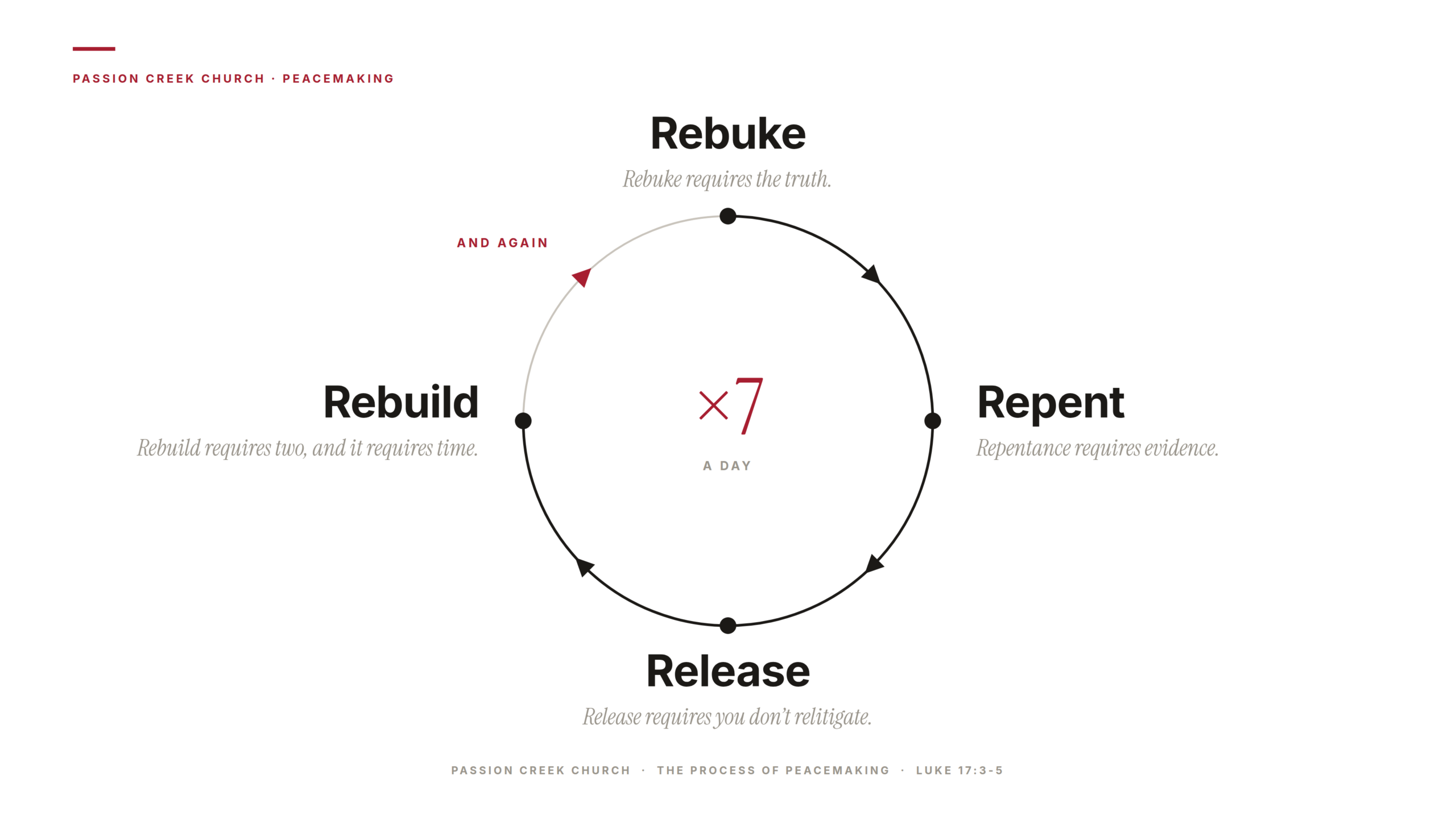
In Luke 17, Jesus gives it in a single sentence. If your brother sins, rebuke him, and if he repents, forgive him, even seven times in a day.
— Offenses will certainly come
Jesus does not say offenses might come. He says they will. Even as He brings the kingdom of God to earth, He never promises a life where people stop disappointing us.
But look at the word He uses. Skandalon, where we get our word scandal, and it pictures a trap. The bait always looks friendly. You reach for it, and the snare closes.
So He is not describing everything that bruises our feelings. He is describing something that causes real harm.
— Hurt is not the same as harm
Most of the best things for you will hurt you without harming you. Correction hurts. Truth in love hurts. Neither one harms. Most of the worst things will not hurt at all, and will harm you anyway.
This matters when we talk about church hurt. Church hurt is real. Leaders can misuse authority, manipulate people, and betray trust, and when that happens we should never spiritualize it, minimize it, or excuse it. But we also cannot call everything that hurts us harmful. Sometimes Scripture confronts us. Sometimes our community corrects us.
Before the process begins, ask the honest question. Was I actually wronged, or do I simply feel wronged?
01 Rebuke requires the truth.
To rebuke is to address the sin directly. It does not mean passive aggression. It does not mean hinting and hoping they connect the dots. It does not mean talking to everyone except them. For me it means putting it on the calendar, so nobody gets ambushed.
It cannot run on hearsay, and it has to be about their actions rather than my judgment of their intentions. Avoiding the conversation is not avoiding the conflict. It only makes it worse the longer you wait.
02 Repent requires evidence, not eloquence.
Repentance is a change of mind that changes direction and eventually changes behavior. It does not mean the person is now perfect. It means they are no longer defending the direction they were going.
Saul said the words. He said, "I have sinned," and went hunting David again. His sorrow was eloquent. His repentance was never evident. Sorrow is emotional. Repentance is directional.
03 Release requires you don't relitigate.
To forgive is to release someone from the debt they owe, surrendering the right to make them pay. Before forgiveness is a feeling we experience, it is a debt we release.
Sometimes healing requires us to revisit the situation, and there is a difference between revisiting for healing and relitigating for punishment. Revisiting says there is still something here I need to work through. Relitigating says you still owe me.
04 Rebuild requires two, and requires time.
You can forgive someone by yourself. You cannot rebuild by yourself, and you cannot force anyone to trust you again. Release can happen in a moment. Rebuild happens over the marathon.
This is why boundaries are often wise. A boundary does not say I have not forgiven you. It says I have released the debt, and trust still needs to be rebuilt. Forgiveness can be freely given. Access is rebuilt over time.
— What if they never repent?
The sequence is hard to ignore. Rebuke, then repent, then release. So is Jesus giving us permission to hold on to bitterness until somebody finally apologizes?
No. We interpret the Bible with the Bible, and in Mark 11 Jesus says that whenever you stand praying, if you have anything against anyone, forgive. I can release someone who never repents. I can surrender my desire for revenge and place the debt in the hands of God. What I cannot do is rebuild with someone who refuses to own it.
Release requires one. Rebuild requires two. Their refusal may change the relationship, but it does not have to imprison my heart.
— Be on your guard
Notice how Jesus opens the whole thing. Before He hands us a single step, He says pay attention to yourselves. Watch yourselves. Before you take someone else through the process of peacemaking, it is imperative that you take yourself through it first.
Jesus says it another way in Matthew 7. Why do you see the speck in your brother's eye but fail to notice the log in your own? Peacemaking has to happen in me before it can happen through me.
Release requires one. Rebuild requires two.
For your group this week.
Peacemaking Week 3 · August 16, 2026
Communion
As your group gathers together, begin by sharing communion as a meal. Feel free to use the following template as a way to structure and guide this time.
Pass out the elements. Make sure everyone has a cup of juice and bread. Consider just having one piece of bread that everyone can take a small piece from. If you do not have bread and juice, that is okay. Just make sure everyone has something to eat.
Read 1 Corinthians 11:23-26. Once everyone has the elements, have someone read this passage out loud.
Pray over the bread and juice. After the reading, have the leader or host bless the food and pray over your time together.
Share a meal. Share the rest of the meal like you normally would, beginning with the communion elements.
Learn
Read Luke 17:1-5 together. Then read this overview.
When it comes to the practice of peacemaking, Jesus is remarkably clear about two things. First, offenses will come. Conflict, disappointment, hurt, and sin are unavoidable parts of life when we live in community with others. But second, how we deal with these offenses is entirely up to us.
Our capacity to make peace will only be as high as our capacity to extend forgiveness, releasing others from the debt they owe us and surrendering our right to make them pay for what they have done. Forgiveness does not mean pretending the offense did not happen, excusing what was done, or automatically restoring trust. It means choosing to release the debt to God rather than continuing to demand repayment ourselves.
Rebuke. Address what is true. Tell the truth about what happened rather than relying on hearsay, assumptions, or judgments about someone's intentions.
Repent. Turn from sin. Repentance is more than saying "I'm sorry." It is a change of direction that becomes visible in our actions.
Release. Forgive the debt. We surrender our right to retaliate or make someone pay for what they have done.
Rebuild. Rebuild trust and relationship over time. Forgiveness can happen with one person, but rebuilding requires two.
But Jesus gives us an important warning. Watch yourselves. Before we begin taking someone else through the process of peacemaking, we need to allow Jesus to take us through it. The process of peacemaking must start with us allowing ourselves to be confronted and rebuked by the Holy Spirit.
Discuss Together- What stood out to you from Luke 17:1-5?
- Jesus opens with "watch yourselves" before he gives a single step. Why do you think he starts there instead of with the process?
- In your own words, what is the difference between being hurt by something and being genuinely harmed by something?
- Why is it important to distinguish forgiveness from reconciliation? What is the difference?
- Before we ask, "What does this person need to do?" what might it look like to ask, "What is mine to own?"
Practice
Each week will include a Group Practice and a Growth Practice. The Group Practice is meant to be done together during your gathering. The Growth Practice is for the week ahead.
Group Practice · Find Yourself in the ProcessPeacemaking is not just something we learn about. It is something we practice. Before we take anyone else through this process, we locate ourselves inside it.
- Take two minutes of silence. Bring to mind one relationship where peace is unfinished. Do not name the person out loud tonight.
- Find it on the map. Which of the four stages is that relationship sitting at right now, and which stage is it stuck before?
- Go around the room. Share only the stage and one sentence about why it is stuck there. For example, "Mine is stuck before rebuke, because I keep hoping it resolves itself."
Hold on to that relationship. This week's Growth Practice is where you take it through the process.
Growth Practice · Watch YourselfThis week, begin applying this process to your current relationships and conflicts. Bring one unresolved relationship before Jesus and take yourself through the process, using these prompts from Sunday:
- Rebuke yourself. Jesus, what is true about me in this situation?
- Repent yourself. Jesus, what do I need to own and turn from?
- Release them. Jesus, what debt am I still demanding they pay?
- Rebuild. What would it look like to move toward them, not to win or to punish, but to make peace?
Reflect
Reflection is vital to transformation. We are changed not just by our practices and habits, but through slowing down to reflect on those practices and habits.
This week, as God brings conflicts and relationships to your mind, pay attention to what He is revealing in you through this practice. Where do you feel resistance to peacemaking?
Process
Next time we gather, we will process together by returning to the Growth Practice, bearing witness to what God did, or did not do, in you this week by sharing what we have reflected on. But because this is our first week back together, we are going to take some time to think back over the last few weeks. We have been talking about the people and the posture of peacemaking, and we have considered the kind of people we are becoming and what we bring into conflict. Now we begin putting that formation into practice.
Discuss- As we have talked about peacemaking, what has God been bringing to your attention?
- Where have you noticed yourself responding differently to conflict, disagreement, or relational tension?
- Have you experienced a recent moment where you practiced humility, gentleness, patience, or bearing with someone in love? What happened?
- Where do you still see God forming you?
- As we practice peacemaking together this season, what is one thing you want to pay attention to in yourself?
Pray
Spend the final few minutes praying for one another. Ask Jesus to form you into people who make peace, not by avoiding conflict or pretending everything is fine, but by telling the truth, practicing repentance, releasing debts, and patiently rebuilding what can be rebuilt.
Then have someone read this benediction over your group.
"Now may the Lord of peace himself give you peace at all times and in every way."2 Thessalonians 3:16
The conversation continues on the Formed by Jesus Podcast.
New episodes go further into the ideas behind each teaching.