

The whole teaching, one section at a time.
Open whichever part you need this week.
– Church is a full contact sport
Nobody sits you down and tells you this when you join a church, but church is a full contact team sport, and sometimes your teammates are the ones who hurt you the worst.
Conflict in the church is not a sign that something has gone wrong. It is assumed. The question is not whether we will be hurt, but what we will do with the hurt when it comes.
01 Tell the truth about what happened.
Paul starts where we would rather not. Speak the truth, he says, because we are members of one another.
Peacemaking is not pretending. Christians can lie, betray, manipulate, neglect, gossip, abuse authority, and fail one another, and the hurts we pick up inside the church usually land harder than the ones we pick up outside it, because of what we hoped church would be.
None of that gets explained away. It gets named, and named with more clarity than we usually manage.
– The window of our pain
Two questions sort most of it out. Where did this come from, a person or a system? And what is my place in it, did I experience it or witness it? Those two questions make four very different sentences.
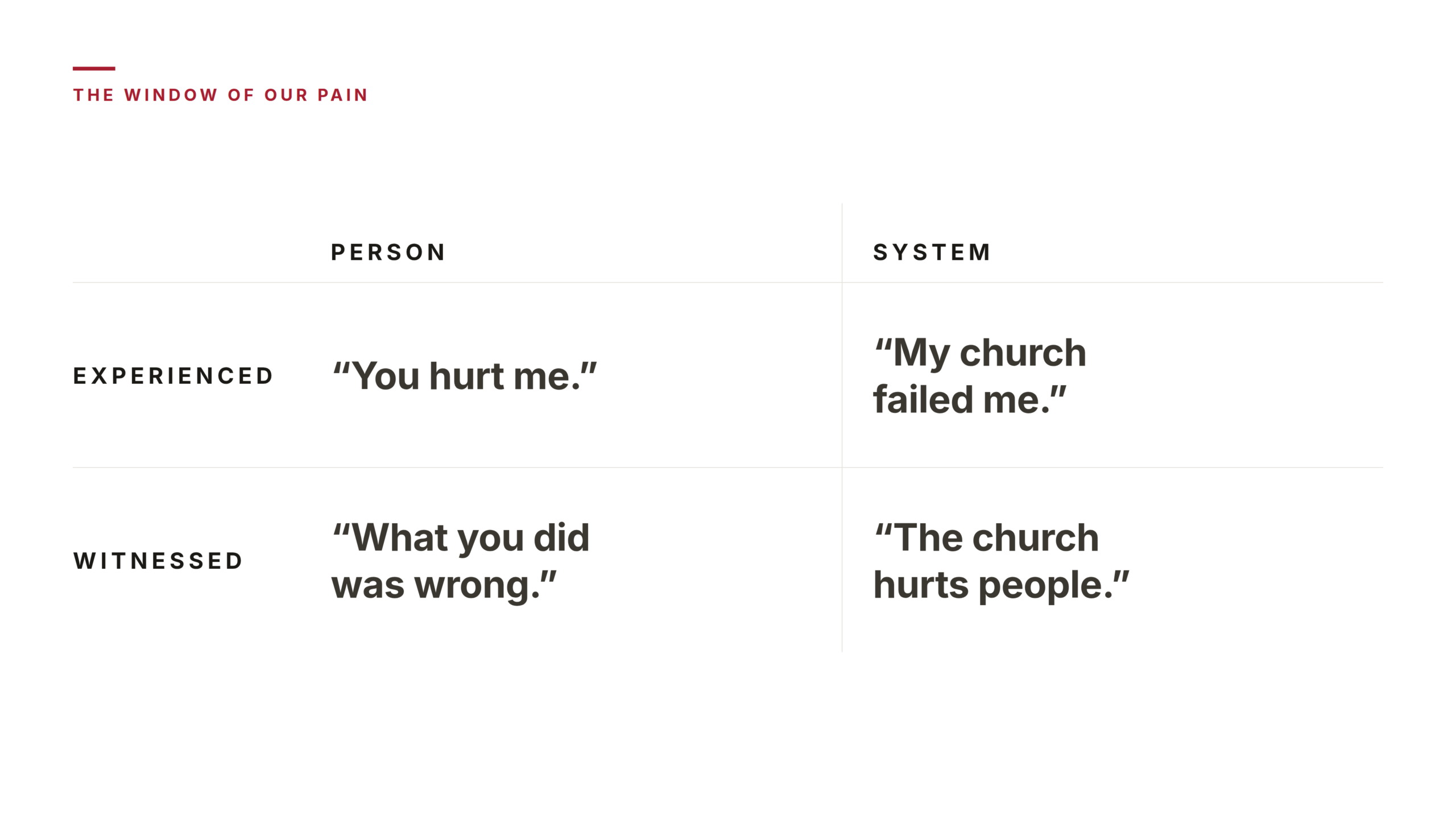
"You hurt me." A friend betrayed you, a leader manipulated you. There is a person to go to, and reconciliation is the pathway.
"What you did was wrong." You watched it happen to someone else, and it turned out to be a pattern.
"My church failed me." Nobody called when you were sick. You burned out and no one noticed.
"The church hurts people." Abuse scandals, celebrity pastors, financial corruption, political hypocrisy. It ends in one sentence, I don't trust the church, and there is no one left to reconcile with.
– Reconciliation requires relationship. Healing doesn't.
Sorting the hurt matters because pain migrates. What starts with a person becomes a church, then the church, then God.
Some hurts have someone to go to. Some never will. Confusing the two is what keeps people stuck for years, waiting on a conversation that is never going to happen before they will let themselves heal.
And hurt that never gets told the truth about does not stay put. Paul says it comes back out as bitterness, anger, shouting, slander, and malice.
02 Pursue peace where peace is possible.
Your hurt is real, and the anger you feel is not necessarily sin. What you do with it is another matter. You are responsible for yourself, not for what was done to you.
Romans 12 gives the rule. If possible, so far as it depends on you, live peaceably with all. Both halves of that sentence are doing work. So far as it depends on you means go, and if possible means it may not be.
Where it is possible, it can take all of this: a conversation, confession, repentance, forgiveness, restitution, rebuilt trust, and reconciliation. Pursue it when you can.
03 Release what cannot be repaired.
Put away the bitterness. Not because the wound did not matter, but because Jesus wants the wound to heal. Be kind, be tenderhearted, forgive one another, because God in Christ forgave you.
Forgiving looks a lot like releasing, handing God a weight you have been carrying.
– In the messy middle
Here is why this is so hard. We live between the already and the not yet, and two invitations meet us there.
Consider trusting the church again. C. S. Lewis said that if you want to keep your heart intact you must give it to no one, and lock it up safe in the casket of your selfishness, where it will not be broken but will become unbreakable. A heart that hurts is better than a heart too cold to be hurt.
And if that is too much right now, consider heaven. For many of our hurts, only heaven will give the healing we long for, and with it something better still. He will wipe away every tear from their eyes.
Pursue what is possible. Release the rest.
For your group this week.
Peacemaking Week 4 · August 23, 2026
Communion
As your group gathers together, begin by sharing communion as a meal. Feel free to use the following template as a way to structure and guide this time.
Pass out the elements. Make sure everyone has a cup of juice and bread. Consider just having one piece of bread that everyone can take a small piece from. If you do not have bread and juice, that is okay. Just make sure everyone has something to eat.
Read 1 Corinthians 11:23-26. Once everyone has the elements, have someone read this passage out loud.
Pray over the bread and juice. After the reading, have the leader or host bless the food and pray over your time together.
Share a meal. Share the rest of the meal like you normally would, beginning with the communion elements.
Learn
Read Ephesians 4:25-32 together. Then, read this overview:
We've discussed the people, posture, and process of peacemaking. Now we begin looking at how to apply all of this to the different situations and relationships we're in where peacemaking might be required. We start with the church. It's no secret that the church, God's own people, can be both one of the biggest blessings and one of the biggest sources of pain for us. Sometimes other Christians will lie, betray, manipulate, neglect, gossip, abuse authority, or simply fail us.
But in Ephesians 4, Paul names this reality and gives us a way forward. Peacemaking is not pretending those things don't happen. Paul begins by telling us to "put away falsehood" and speak truthfully to one another. But speaking truth about our hurt requires us to tell the truth about where that hurt came from and who is responsible for it.
Our pain can take different forms. Sometimes someone hurts us personally. Sometimes we witnessed something wrong. Sometimes the church failed us institutionally. And sometimes our pain becomes representative. These distinctions matter because reconciliation requires relationship, but healing doesn't always require reconciliation.
Paul gives us a way forward: pursue peace where peace is possible, and release what cannot be repaired. We do this not because the wound doesn't matter, but because Jesus does not want our wounds to become bitterness. By honestly examining our church hurt, we can move from pain to healing as we continue growing together alongside God's people.
Discuss Together- What stood out to you from Ephesians 4:25-32?
- Why do you think Paul connects truthfulness, anger, speech, bitterness, kindness, and forgiveness in the same passage?
- What's the difference between pretending you're not hurt, and pursuing peace with your hurt?
- Why might it be helpful to distinguish between "You hurt me," "What they did was wrong," "My church failed me," and "The church hurts people"?
- In Romans 12:18 Paul tells us "If possible, as far as it depends on you, live at peace with everyone." What might this look like within our own church community?
Practice
Peacemaking begins by telling the truth. Work through these steps together right now.
| Person | System | |
|---|---|---|
| Experienced | "You hurt me." | "My church failed me." |
| Witnessed | "What you did was wrong." | "The church hurts people." |
- Take a few quiet moments and bring to mind a hurt connected to the church. This could be something someone personally did to you, something you witnessed, a way the church failed you, or a broader experience that has affected your trust in the church, either Passion Creek or another church.
- As a specific hurt comes to mind, recall the "Window of Our Pain" from Sunday's teaching. When it comes to this specific hurt, where do you find yourself on the window? Have you allowed this hurt to grow into bitterness?
- Share with your Group: what is the source of this hurt and what was your experience with it? You don't need to name the person or share details that you aren't comfortable sharing.
Try to avoid divulging into unhelpful specifics, bitterness, or gossip. The goal here isn't to bash other people or church, nor is it to heal the hurt completely. It's simply to tell the truth about it honestly.
Growth Practice · Pursue PeaceContinue bringing the relationship you identified last week before Jesus. Ask yourself: Is there a step toward peace that is mine to take? If peace is possible, consider what your next step might be:
- A conversation
- Confession
- Repentance
- Forgiveness
- Restitution
- Rebuilding trust
- Reconciliation
Reflect
Reflection helps us slow down enough to notice what God is doing in us. As you think about the church hurt you identified, ask Jesus to show you what is happening beneath the surface.
Discuss Together- What emotions come up when you think about this hurt?
- Where do you notice anger, bitterness, fear, distrust, or defensiveness?
- Where might Jesus be inviting you to pursue peace?
- Where might Jesus be inviting you to release something you cannot repair or control?
Process
Returning to last week's Growth Practice and reflecting on everything we've learned so far, spend the last few moments of Group processing together:
Discuss- Thinking back on your own relationships, hurts, and conflict, has there been any movement toward rebuke, repentance, release, or rebuilding? What did that look like?
- Where do you still feel resistance towards peacemaking?
- What's one invitation or next step Jesus might be calling you to take?
Pray
Spend the final few minutes praying for one another. Ask Jesus to form you into people who make peace, not by avoiding conflict or pretending everything is fine, but by telling the truth, practicing repentance, releasing debts, and patiently rebuilding what can be rebuilt.
Then, have someone read this benediction over your group.
"Now may the Lord of peace himself give you peace at all times and in every way."2 Thessalonians 3:16
The conversation continues on the Formed by Jesus Podcast.
New episodes go further into the ideas behind each teaching.