

The whole teaching, one section at a time.
Open whichever part you need this week.
— When you can't change where you work.
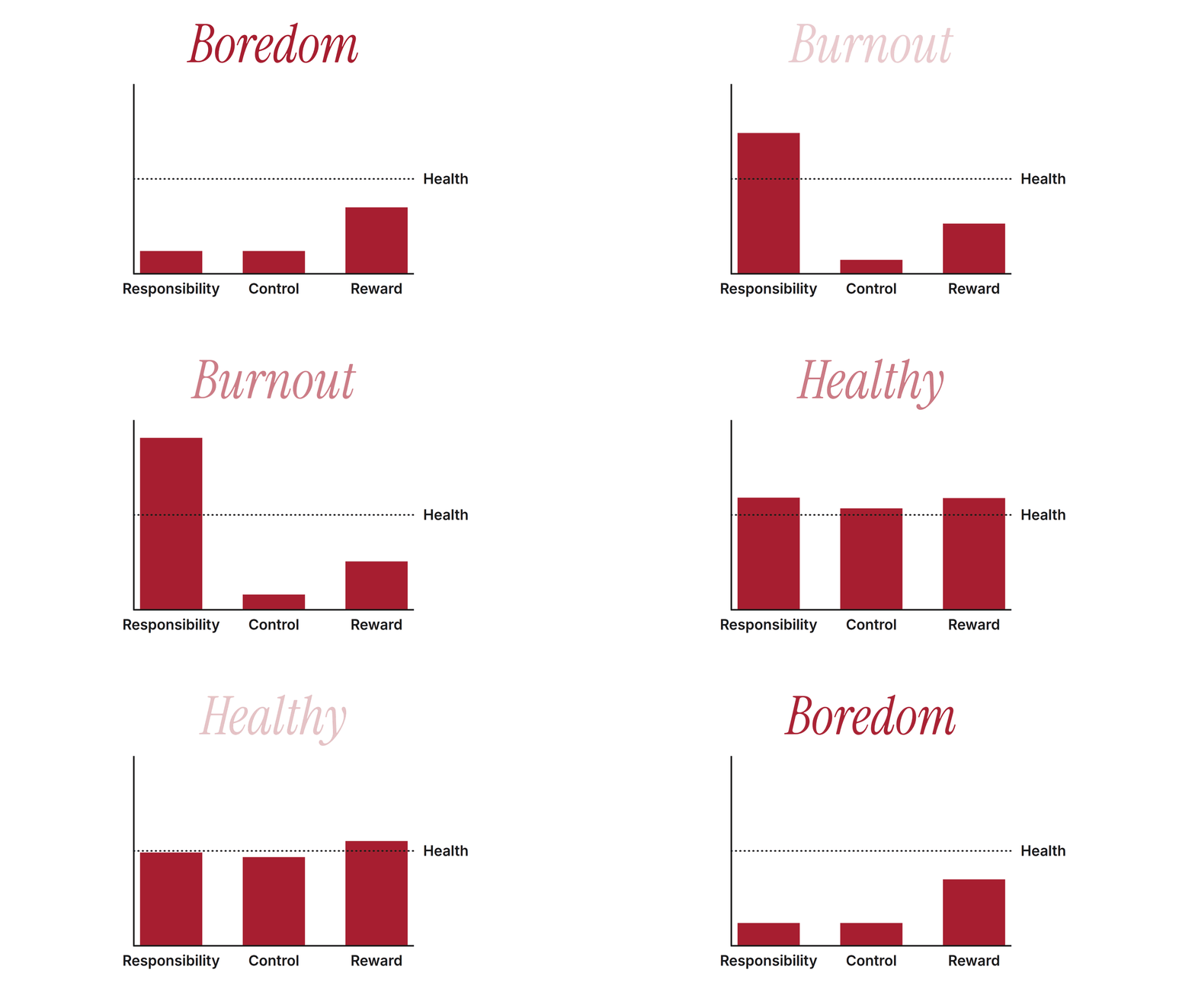
Three things determine whether our work is healthy: responsibility (how much is expected of you), control (how much say you have), and reward (what you get back: money, time, margin, meaning). When responsibility and control are low, you feel the pain of boredom. When responsibility is high but control and reward are low, you feel the pain of burnout. In boredom, you wonder if you matter. In burnout, you wonder if it matters.
The frustrating part is that you often can't change those variables for a long time. And that isn't necessarily a sign you're in the wrong career. Tim Keller: "You should expect to be regularly frustrated in your work even though you may be in exactly the right vocation." Since Genesis 3, work comes with thorns and thistles. Work is cursed, but it isn't a curse. It is still good. It just no longer works like it should.
So how do you make peace at your work when you can't change where you work? Paul writes Ephesians 6 to people with remarkably little control over their working conditions. He doesn't begin by changing where they work. He changes how they work and who they work for.
01 Paul isn't endorsing slavery. He's addressing Christians living inside of it.
Roman slavery was different from American chattel slavery, but it was still slavery. It wasn't based on race; people became enslaved through war, debt, or birth. Enslaved people made up much of the workforce, including doctors, teachers, and administrators, and many were eventually freed. But these were still human beings owned by other human beings. Slavery is evil and is not God's design.
Paul didn't create the institution, and Ephesians 6 isn't his political blueprint for Rome. He is pastoring Christians already inside a deeply broken system. And notice what he does: he speaks to enslaved people as brothers and sisters responsible before Jesus, tells masters to stop threatening them, reminds masters they have a Master too, and says God shows no favoritism between them. Elsewhere he tells enslaved Christians to take their freedom if they can. Centuries later, Christians like William Wilberforce led the way in abolishing slavery. Using this passage to justify slavery is twisted and wicked.
02 Four marks of a Spirit-filled employee.
In Ephesians 6:6-8, Paul shows us how to work faithfully among the thorns and thistles. Notice that Christ is named in every verse: "as you would Christ," "as slaves of Christ," "as to the Lord," "from the Lord." A Spirit-filled employee works:
Respectfully. "Fear and trembling" doesn't mean you cringe. You honor the position and realize it's probably harder than you think. Sincerely. Sincerity of heart means no hidden agenda and no ulterior motives. Willingly. You serve with a good attitude, not begrudgingly. Expectantly. "Whatever good each one does, he will receive this back from the Lord." Christ will reward us on the last day.
03 When we aren't compensated enough, we turn to people-pleasing.
Reward is a real motivator in our work, and God isn't embarrassed by that. But when we forget the intangible rewards, the dignity of contributing and the reward Christ promises, the reward bar always looks too low. When we feel like we aren't compensated enough, we take compensation into our own hands through people-pleasing.
Paul seems to have coined a word for it in verse 6: ophthalmodouleia, eye service. It's working for the eyes of the people above you. And eye service traps us two ways: you're lazy when no one is looking, and you're crushed when no one is commending. Those look like opposites, but they're the same problem. I've made my boss's eyes too important.
Paul's answer is to change whose eyes you work under. I don't have to prove I'm working hard when I know who I'm working for.
04 When we don't have enough control, we turn to power-wielding.
Verse 9 turns to the people with power: "Treat your slaves in the same way. Do not threaten them, since you know that he who is both their Master and yours is in heaven, and there is no favoritism with him." When we feel like we don't have enough control, we take control into our own hands through power-wielding. We control others to console ourselves.
You don't have to own a company for this to apply. Anyone with a little authority, over a team, a classroom, or a household, feels the pull. The person with power must remember that they are also under power. If Jesus is my Master, I don't have to perform for you. And if Jesus is my Master, I don't get to lord myself over you.
— Christ is our Reward. Christ is in Control.
People-pleasing chases the reward we feel we're missing. Power-wielding grabs the control we feel we're missing. The gospel answers both. Christ is our Reward, so we don't have to perform for approval. Christ is in Control, so we don't have to wield power to feel secure. The gospel frees us from performing when we're powerless and from controlling when we're powerful.
So take an honest look at your actual job. Is the way you work exploitative (using people), ethical (respecting people), or redemptive (blessing people)? Followers of Jesus are invited into redemptive work for the glory of Christ.
Christ is our Reward. Christ is in Control.
Making Peace With Your Work
For your Together Group this week. Share a meal, open the text, practice peace at work.
Communion
As your group gathers together, begin by sharing communion as a meal. Feel free to use the following template as a way to structure and guide this time:
1. Pass out the elements. Make sure everyone has a cup of juice and bread. Consider just having one piece of bread that everyone can take a small piece from. If you don’t have bread and juice, that’s okay. Just make sure everyone has something to eat.
2. Read 1 Corinthians 11:23-26. Once everyone has the elements, have someone read this passage out loud.
3. Pray over the bread and juice. After the reading, have the Leader or Host bless the food and pray over your time together.
4. Share a meal. Share the rest of the meal like you normally would, beginning with the communion elements.
Learn
Read Ephesians 6:5-9 together. Then read this overview:
In the last week of our Peacemaking Practice, we focus on our work. For most of us, our jobs and careers carry significant weight in our lives. Sometimes that weight is a blessing, where we feel like our work is fruitful and we get more joy than frustration from it. For others, work is a burden where we feel like we lack responsibility, control, or reward. In either case, God created us to work, which means that while our work is cursed by sin, it can be redeemed. In Ephesians 6, Paul gives us some helpful instructions we can use to begin making peace with and within our work. Our work can be redeemed if we commit to working respectfully, sincerely, willingly, and expectantly, remembering that ultimately we work for Christ.
- If you were there on Sunday or listened to the teaching online, what stood out to you?
- In general, how do you feel about your work? Is it more often a burden, or a blessing to you?
- When it comes to your work, where do you tend to feel more tension: responsibility, control, or reward? Why?
- In verse 6 Paul warns us against working as “people-pleasers.” In what ways are you tempted to people-please in your work?
- In what ways are you tempted towards power-wielding? What does that tend to look like in your work?
- Where might you be trying to control something at work that ultimately isn’t yours to control?
Practice
Though we were made to work, our work can often feel out of alignment with God’s will. One way we can begin seeing our role in the workplace as peacemakers is to examine what an exploitative, ethical, and redemptive version of our work looks like.1
Exploitative work asks: “How can I use this job for myself?”
How can I get the most while giving the least? How can I use customers, coworkers, or employees for my advantage?
Ethical work asks: “How can I do this job the right way?”
Am I honest? Am I fair? Do I keep my word? Do I treat people with dignity?
Redemptive work asks: “How can I use this job for the good of others?”
How does my work contribute to human flourishing? Who does my work allow me to serve? How can I leave this little corner of the world better than I found it?
1 Adapted from Praxis, “The Redemptive Frame: Three Ways to Work,” in Redemptive Business: First Principles.
Reflect on the work you do, whether it’s in the workplace, at school, or in the home. Then, discuss with your Group:
- What would an exploitative version of your work look like?
- What would an ethical version of your work look like?
- What would a redemptive version of your work look like?
This week, do one thing at work that costs you something but makes someone else’s work better. It could be something as simple as:
- Giving away credit
- Helping without being asked
- Sharing the love of Jesus
- Offering a word of encouragement to a coworker
Reflect
We don’t just grow from our practice, we grow when we reflect on our experiences. Discuss the following question together:
- How did last week’s practice of spending time with your children go?
Process
As we close out our Peacemaking Practice, spend the last few minutes reflecting with each other by discussing these questions:
- What have been some highlights from this practice? Where have you seen God bring growth, peace, or change?
- What have been some low points or challenges? Where did you struggle to put peacemaking into practice?
Pray
Spend the final few minutes praying for one another. Then, have someone read this benediction over your group.
“Now may the Lord of peace himself give you peace at all times and in every way.”2 Thessalonians 3:16
The conversation continues on the Formed by Jesus Podcast.
New episodes go further into the ideas behind each teaching.