

The age of the trickster
Every civilization has a name for him. The Polynesians call him Maui. The Norse, and Marvel, call him Loki. The Greeks named him Odysseus. Paul describes him in Ephesians 4:14 as human cunning. The trickster is never direct. He is always disguised. What looks like a gift can carry an army. What looks like peace can hide a war. And once you've survived enough Trojan Horses, you stop trusting gifts altogether. Every apology might have an agenda.
Which is where we find ourselves. We've learned the language of peacemaking without living the virtues of peacemaking. We know the words: forgiveness, boundaries, accountability. We can even have ChatGPT write our apology texts. The problem is that it can give us the script but never the soul. Techniques, devoid of transformation, are just a bag of tricks.
But Paul isn't only preaching about the manipulators out there. He warns us about the manipulator in here. When you've been manipulated, it gets easy to justify retaliation. Which is why he gives us the posture before he ever gets to the process.
"Without the posture of Christ, peacemaking is no longer a practice that matures us, but a ploy to manipulate others."
Ephesians splits right down the middle. Chapters 1 through 3 tell us what Christ has done. Chapter 4 opens with therefore. Peace has been received. Here is how peace gets practiced. Paul gives us the posture in four steps. But it isn't a staircase you climb up. It's steps you go down.
Because ever since Genesis 3, humanity has been climbing. We climb for significance, for status, for control. And when someone hurts us, we don't want to move toward them. We'd rather tower over them. But reconciliation happens at eye level. Every virtue Paul names is another step down. The good news is not that we found a way up to God's level, but that God came down to ours.
"Peace was made when God took the first step down. So it shouldn't surprise us that Paul's first instruction to peacemakers is to start coming down too."
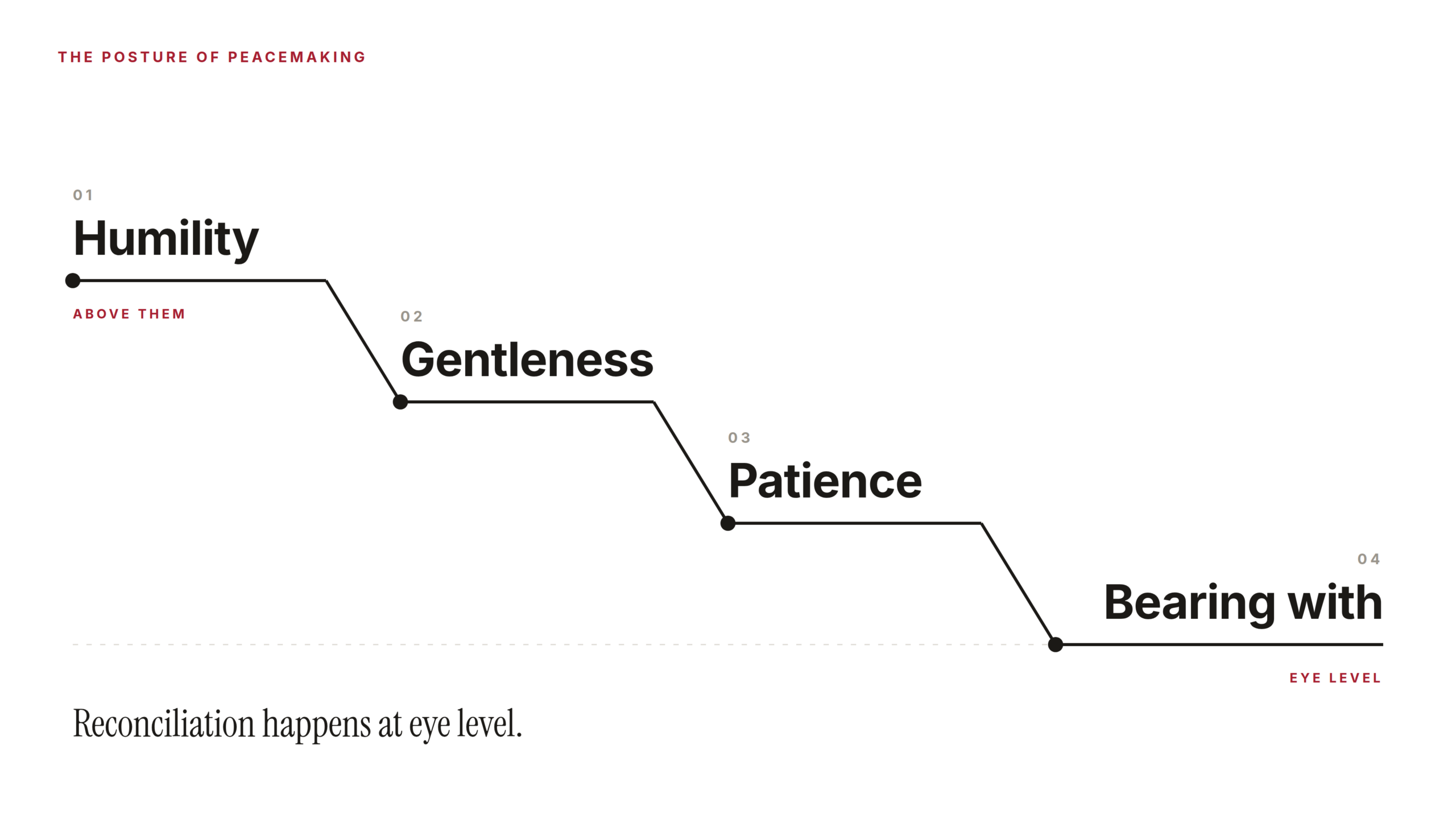
Four steps down, not up.
Every virtue Paul names moves you lower, toward the person you'd rather stand above.
Humility
Paul says all humility, in every relationship, every disagreement, every conflict. It isn't self-hatred, and it isn't pretending you have no gifts. As Lewis put it, humility isn't thinking less of yourself; it's thinking of yourself less.
Gentleness
Gentleness is power held in reserve. The Greeks pictured a trained horse: unmatched strength that submits to the bridle. It's having the power to retaliate and choosing restraint, the ability to wound and choosing to heal.
Patience
Patience means slow to become angry. It isn't impressive to be humble and gentle for a moment; the real test is when the moment becomes a marathon. Seventy times seven isn't a spreadsheet. It's a heart that stopped keeping score.
Bearing with one another
It simply means putting up with each other. The gospel doesn't eliminate irritation; it empowers us to endure it. This church doesn't work because we're all the same. We are very different, and that's to the glory of God.
Just as skipping steps on the way down a staircase can send you tumbling, so can skipping humility.
The trickster who was transformed
The Hebrews had a name for the trickster too. Jacob, whose name means to deceive. He manipulated his brother, deceived his father, and spent his life climbing over people to get ahead. Every culture has a story about a trickster. Scripture has the story of a trickster who was transformed.
Twenty years later, God called Jacob home to make peace with Esau. But the turning point wasn't the meeting. It was the night before, when Jacob wrestled with God and realized his greatest conflict had never been with his brother. It was with God. Genesis 33 says he approached Esau bowing to the ground seven times. The man who had spent his whole life climbing was finally learning how to come down. He stopped manipulating and started maturing.
The trickster became a peacemaker.
That's the prayer for every one of us. Once we've encountered the goodness of God, we no longer need to climb. We simply come down. We drop the ploy and embrace the posture.
Take one step down this week.
- Ask the Holy Spirit: who am I trying to stand above?
- Then choose one act of humility.
- One act of gentleness.
- One act of patience.
- One act of bearing with someone in love.
Peace begins the moment we stop climbing and start coming down.
The conversation continues on the Formed by Jesus Podcast.
New episodes go further into the ideas behind each teaching.